
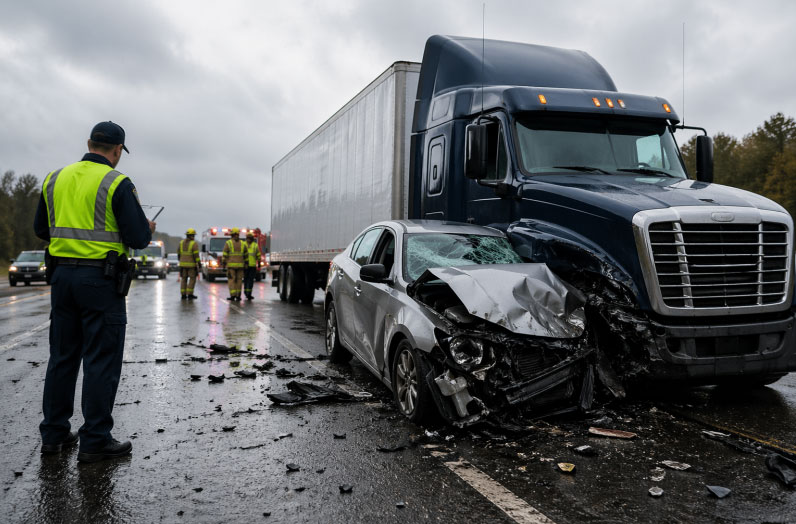
Truck accidents are not just “bigger” car accidents—they are legally and factually more complicated.
If you or a loved one has been involved in a collision with a commercial truck in South Carolina, understanding these complexities can help you make informed decisions about your next steps.
At Seaton, Duncan, & Holmes, clients often ask why truck accident claims take longer or involve more legal hurdles than standard car accident cases.
The answer lies in the unique combination of federal and state regulations, multiple liable parties, and high-stakes damages that define these cases.
Key Differences Between Truck and Car Accident Cases
1. Multiple Parties May Be Liable
In a typical car accident, liability usually falls on one or two drivers. In contrast, truck accident cases often involve several potentially responsible parties, including:
- The truck driver
- The trucking company
- The vehicle manufacturer
- Maintenance providers
- Cargo loading companies
South Carolina follows a modified comparative negligence rule under S.C. Code Ann. § 15-38-15, which means fault can be divided among multiple parties.
You can review the statute here.
Determining who is responsible requires a detailed investigation, often involving accident reconstruction specialists and industry experts.
2. Federal and State Regulations Apply
Commercial trucks are governed by strict federal regulations enforced by the Federal Motor Carrier Safety Administration (FMCSA). These rules cover:
- Hours-of-service limits (to prevent driver fatigue)
- Vehicle maintenance standards
- Cargo loading requirements
- Driver qualifications
Violations of these regulations can significantly impact liability. Courts in South Carolina may consider regulatory violations as evidence of negligence, as seen in cases reviewed through the South Carolina Judicial Branch.
This added regulatory layer makes truck accident cases far more complex than standard car accident claims.
3. More Severe Injuries and Damages
Due to their size and weight, commercial trucks often cause catastrophic injuries, including:
- Traumatic brain injuries
- Spinal cord injuries
- Multiple fractures
- Long-term disability
South Carolina law allows injured victims to seek compensation for both economic and non-economic damages. In severe cases, punitive damages may also be available under S.C. Code Ann. § 15-32-520.
👉 You can read the statute here.
Because the financial stakes are higher, insurance companies aggressively defend truck accident claims, adding another layer of complexity.
The Role of Evidence in Truck Accident Cases
1. Black Box Data and Electronic Logs
Commercial trucks often contain electronic logging devices (ELDs) and “black box” systems that record:
- Speed
- Braking patterns
- Hours driven
This data can be critical in proving fault but is not always easy to obtain. Trucking companies may act quickly to preserve—or sometimes limit access to—this evidence.
2. Maintenance and Inspection Records
Unlike passenger vehicles, commercial trucks must undergo regular inspections. Maintenance logs can reveal whether:
- The truck was improperly maintained
- Safety checks were skipped
- Mechanical failures contributed to the accident
Accessing and analyzing these records requires legal experience and persistence.
3. Accident Reconstruction
Truck accident scenes are often more complex due to:
- Larger impact areas
- Multiple vehicles
- Extensive property damage
Accident reconstruction experts may be needed to determine how the crash occurred, which adds time and cost to the case.
Insurance Challenges in Truck Accident Claims
Trucking companies typically carry large commercial insurance policies. While this may seem beneficial, it often leads to:
- More aggressive defense tactics
- Quick settlement offers that undervalue claims
- Lengthy negotiations
Insurance companies have teams of adjusters and attorneys working to minimize payouts. This makes it essential to approach these cases strategically.
Legal Standards and Case Law in South Carolina
South Carolina courts have addressed negligence and liability in personal injury cases through various rulings. For example, the state recognizes that a violation of safety regulations can support a claim of negligence per se.
👉 You can explore relevant decisions here.
Understanding how courts interpret these issues is critical when building a strong truck accident case.
Why Legal Representation Matters
Truck accident cases require a deeper level of investigation, legal knowledge, and negotiation skill than typical car accident claims. From identifying all liable parties to interpreting federal regulations, each step presents unique challenges.
Working with a law firm familiar with South Carolina personal injury law can help ensure that:
- Evidence is preserved early
- All responsible parties are identified
- Compensation reflects the full extent of your damages
Frequently Asked Questions (FAQ)
What makes truck accidents more dangerous than car accidents?
Truck accidents often involve significantly larger vehicles, leading to more severe injuries and greater property damage.
How long do truck accident cases take in South Carolina?
These cases can take longer than car accident claims due to complex investigations, multiple parties, and extensive evidence review.
Can more than one party be held responsible?
Yes. Liability may extend to the driver, trucking company, maintenance providers, and others involved in the operation of the truck.
What compensation is available after a truck accident?
Victims may recover damages for medical expenses, lost wages, pain and suffering, and in some cases, punitive damages.
Need Help With Your Truck Accident Case?
Truck accident cases in South Carolina involve more than just determining who caused the crash. They require navigating complex regulations, identifying multiple liable parties, and handling high-stakes damages.
If you are dealing with the aftermath of a serious truck accident, having the right legal guidance can make a meaningful difference in how your case unfolds. Don’t wait to get answers.
Contact Seaton, Duncan, & Holmes to discuss your situation and explore your legal options. Click HERE to schedule a consultation today.
Ready To Speak With An Attorney?
Let’s discuss the details of your case and see if we can help.